
A freshly brewed cup of coffee being brought out of the kitchen would have been an unremarkable scene in an Ethiopian household except that it was happening at 2:00 am on a Friday morning. The host and his guests, including myself, were hanging out on a beautiful balcony of his home overlooking Addis Ababa. A woman lounging by a swimming pool below had mentioned in passing that she was craving coffee. Some time later the host had arrived with an Ethiopian style coffee, complete with cinis and jebena. As he gently poured the coffee into the traditional cups and passed it around to the group immersed in conversation and drunken laughter, I wondered who was awake, purposefully out of sight, in some corner of the mini-mansion watching over a jebena at 2:00 am in the morning?
Welcome to the life of the modern elites of Addis Ababa who live in a society that is crisscrossed by multiple temporalities; one where the old feudal system of reality persists alongside structures of modern capitalism; where the official king and the nobility are gone, but the hierarchical attitudes and belief systems remain intact, intertwined with the post-revolution Ethiopian elite existence of nihilism and decadence. The kind of existence that eventually consumes anyone within its proximity, even those only some years prior I would have sworn it would never touch.
Birtukan Mideksa
By 2008 Birtukan had already experienced the life of a prisoner for nearly two years. The intimate details of prison life were not unknown to her. In 2005 after an unprecedented election season that had shook the Ethiopian government and the following demonstrations which resulted in the deaths of over 200 individuals in Addis Ababa, Birtukan along with her fellow opposition leaders of the political party, Kinijit, journalists and civil society workers were charged with treason for allegedly planning to overthrow the government. All were sentenced to life imprisonment. The group was imprisoned in November of 2005 and released in August of 2007 with a lengthy negotiated deal reached between the government and the members of Kinijit. The government agreed to pardon those it considered criminal if they submit an official letter of apology.
At the time, like most people, I followed the election processes through television. Outside of finding some televised debates intriguing given they were unlike anything we had ever seen, I was a somewhat detached observer who followed the election as if it had no direct impact on my life. In those days much of my free time was spent inside the pages of literature books, hanging out with friends in cafes and restaurants primarily preoccupied with the ordeals of my own existence. Political conversations I engaged in were merely an intellectual exercise, political engagement was nonexistent. So, when I first heard about the imprisonment of Kinijit leaders, I had said with an authoritative tone of an ignorant wiseacre, “what else did they expect? To win the election? The audacity.”
But later, it was precisely the audacity that would be awe striking to me. Especially the audacity of a young woman who, I soon after learned, had shown incredible defiance to the then Prime Minister Meles Zenawi when in 2002 she released from prison Siye Abraha, a former defense minister who a year prior, after an intra-TPLF jockeying, was expelled from the party and arrested. Seye was immediately rearrested as soon as he left the courtroom, but Birtukan’s name echoed across the city as an unprecedented jeg’na of her generation.
…
“Even when we sent elders to advise her to take back her word of denial, she refused to listen and rectify her error,” A confident Meles Zenawi says to a group of journalists. “She assumed pressure from her supporters and outside powers would secure her release. But she was told repeatedly that this is a wrong assumption. We begged her for a month. Who will benefit from this imprisonment? The government has zero to gain from this.” He continues with an almost mocking attitude and a disdain of a man who has run out of patience for the games of naïve children. “It is advisable,” he continues “that such dreams be discarded. But judging by her track record, I doubt she will learn from her mistakes.”
During a Europe tour in November of 2008 to promote Andenet, the new political party she had formed after leaving prison, Birtukan had told an audience that the pardon she and other opposition leaders signed as a condition for their release from prison was the result of a political process and had no formal legal force. This statement was in direct opposition to the agreement she had signed with the Ethiopian regime.
Birtukan had indeed broken her word. In an article published in the pages of Addis Neger titled Qale (my word), Birtukan described being summoned by the then federal police commissioner Workeneh Gebeyeh and given a direct warning. She either retracts her word or she would head back to the infamous Kaliti and spend her remaining years behind prison walls. She wrote, “lawlessness and arrogance are things that I will never get used to, nor will I cooperate with.” She walked out of the office with her head held high, having given the regime the middle finger ready to accept whatever fate that awaited her.
It was evident even the Prime Minister did not want to imprison Birtukan. But her stubbornness could not tolerate even the most reasonable of arguments. Who indeed would benefit from this imprisonment? At this point in time, Kinijit was all but dead. There no longer was a political goal to pursue, there was no personal gain to be had.
When we fail to understand something through reason, we’re forced to dig for something more, to imagine beyond strategies, tactics, and political maneuverings. It seems there was something deeper to her reasoning, a stubbornness to stand on one’s principle, a kind of moral clarity and conviction which chooses a lifetime of imprisonment than to cower to a man and regime who continuously choke any hopes of freedom, liberty and justice that dared spring up under its watch. I have asked myself multiple times why any person would choose this. Maybe an answer could be found in her own writings. In a letter she had penned while in prison, she describes Kinijit to be not just a political party that it had been before the 2005 elections but had transformed to “being the spirit of resistance against tyranny”. It was this tyranny she despised, this tyranny that she could not accommodate in the slightest. The letter had shamed my former self, a self who fancied itself primarily reasonable and rational, a self that thought entertaining romantic notions of freedom, emotion, and living life to the hilt as a game of the childish, of those who haven’t grasped the harsh realities of adult life.
Birtukan spent the succeeding 21 months in Kaliti prison. There are limited reports about her time spent in prison, a significant amount of which was spent in solitary confinement. But it is widely known she suffered intense physical and psychological trauma. Meles Zenawi was never in the habit of putting individuals in prison and throwing away the key. He would continue to extend the offer to reinstate the pardon if she would do the same with her initial words of apology. Birtukan was implored by friends, family, and supporters that this round of prison indeed served no purpose and had no tangible goal. “Think of your innocent child and mother” would have been a successful enough argument. Why endure meaningless suffering? She finally relented. In October of 2008 she submitted a pardon plea, and walked out of prison a free woman, a heroine who had stared the devil in the eye and never blinked. But the decision to choose imprisonment would come at a steep cost, the results of which might help partially explain the Birtukan of Abiy Ahmed’s season.
In 2011, eight months after celebrating her release from prison, Birtukan, no longer able to live in the country under the constant watchful eyes of her tormentors, boarded a plane to the United States to start a new life. Not much detail is known about her life in the US. She lived a mostly private life in Washington, DC raising her daughter. While in the US, according to Wikipedia, she was able to work and study at various institutions including at NED, The National Endowment for Democracy and the Harvard Kennedy School.
After her departure from Ethiopia, pertinent political issues persisted unaddressed. Crackdowns and imprisonment of anti-government activists continued as well. The Oromo Protests which lasted for about 2 years finally succeeded in shaking the regime enough to deliver a power reshuffling; the TPLF lead EPRDF had turned into the one man led Prosperity Party.
…
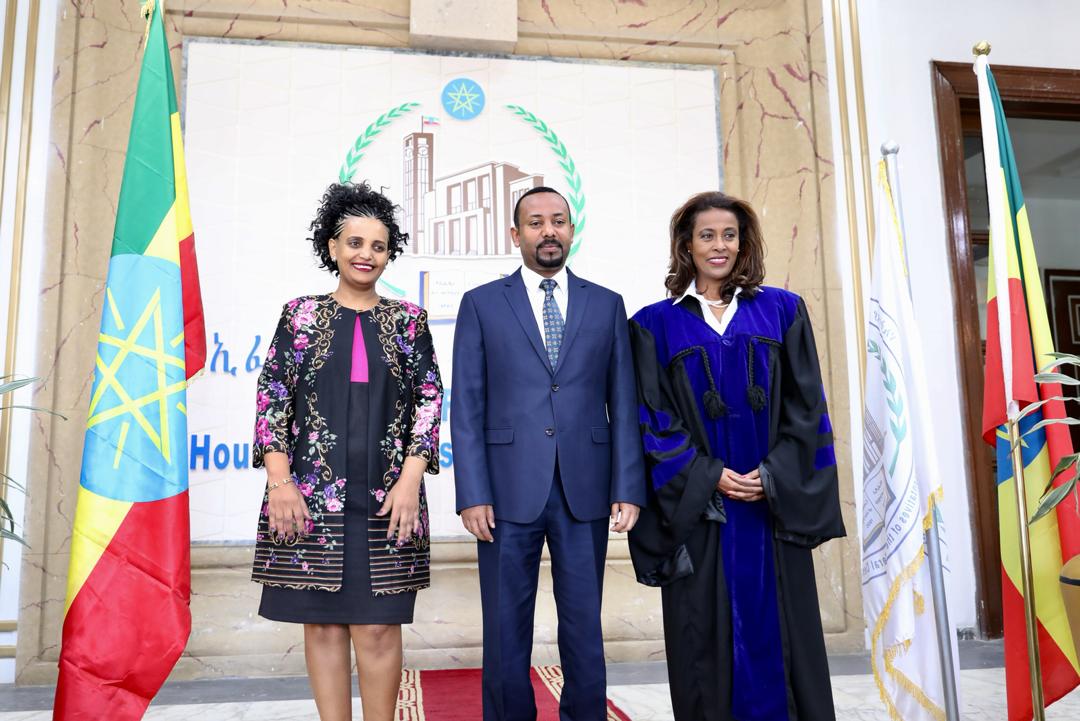
In 2018, Birtukan boarded another flight. This time would be different. She was now crossing the Atlantic back to her homeland to become the head of NEBE, the National Election Board of Ethiopia. The new Prime Minister of Ethiopia, Abiy Ahmed, who had risen to the helm of state power had personally asked her to head the board to guarantee a free and fair election, something he had proudly promised to his people. For most people, the Prime Minister’s idea to choose Birtukan was more than a practical decision, it was a symbolic one. A woman who was forced out of her country by a seemingly indestructible tyranny was given a chance to overlook a process that would do its utmost to guarantee that such tyrannical force would never again grasp state power. For those who had followed Birtukan since her Seye years, witnessing her being sworn in at the Parliament in 2018 was akin to watching a rebirth of the nation itself.
Of course, it turned out this hope was only part of a collective childish dream. Ethiopians were so drunk on the sweet words of Abiy Ahmed, it was forgotten that he was a solid part of the very regime that had broken and buried any forms of resistance along with Birtukan herself. But we are human and our lives are short. How can one blame a people who attempt to fit in as much hope as possible in one life, even when so irrational? It is clear now what Abiy Ahmed saw in Birtukan was not a courageous woman with integrity or a competent one who had clenched a second degree from Harvard while raising a daughter. To him she was, like all the professional elites he has surrounded himself with, an effective tool to be used to swoon Ethiopians and his Western backers into thinking he was a man more interested in democracy than power, a man ready to bring real change. It, soon after, also became apparent that what Ethiopians mostly hoped for was not democracy or justice for themselves but for the destruction and subjugation of their previous rulers who were at the helm of power, including the Tigrayan society they hailed from.
…
Sometime in early 2022 as I mindlessly scrolled through social media, I came across some TV program featuring Lady liberty, as she was affectionately known. While having followed Birtukan for the preceding two years, this new version left me both amused and bewildered. The show is a sort of a-day-in-the -life of prominent people of Addis, and ‘prominent’ she had once again become. To be fair there was no reason for me to be befuddled. By this time, I knew the old Birtukan was long gone. I had spent the preceding two years watching almost every Ethiopian support Abiy Ahmed in his genocidal war against Tigrayans, which eventually took the lives of an estimated eight hundred thousand people. I had watched most regions of the country descend to near anarchy. During this same period Birtukan was orchestrating the postponement of the 2020 Ethiopian election which conveniently helped Abiy clench full power. I had watched her conduct a demonstrably sham election and hail it as democratic. So, I knew the young Birtukan who had captivated and inspired Ethiopians with words like democracy, justice, freedom adorning her lips was long gone.
But I knew only in the mere sense of having information, not in the sort of knowing that involves grasping deeper meanings, subtle emotions, and sinking-to-the-gut kind of knowing. So, I watched in amazement at the new woman inside my computer screen. There was something surreal about watching her in her villa in the center of Bole surrounded by security guards, chit chatting about the difficulty of keeping a work-life balance and sipping on macchiato while reminiscing about an old boyfriend. Where did the defiant, passionate Ferensay Legacion ya’rada lij in flip flops and tight ponytails go? It seemed she had been rebirthed into something else, something I was too familiar with; a careerist elite who hangouts in hotels with a wine glass in hand complaining about Addis traffic while raving about gated recreational parks and shiny streetlights.
…
For the elite of Addis Ababa, Abiy Ahmed was an unexpected Godsent. Somewhat influential but underpaid, unrecognized and underappreciated academics who were barely scraping up a lower middle-class existence were now being invited to cocktail parties at Arat Kilo and offered government positions that provided access to free housing, cars and cash. Ambitious lawyers, economists, and professionals of every ilk who may have found academic and/or professional success abroad in the past but with neither influence nor visibility were now securing jobs at home with impressive international standard pay and the bonus of having house maids, nannies, and drivers. Not to mention the overflow of eager and available beautiful women who are only a DM and a Skylight dinner away. Entrepreneurs in crisp suits and middle-class sensibilities with newfound opportunity to hobnob with key government officials were getting contracts they could have only dreamed of just a few years prior catapulting them to Blue Label Whiskey drinkers practically overnight. The professional elite currently upholding and benefiting from the Abiy government are no different from your average stereotypical rich Merkato trader. Their primary value lies in the zealous accumulation of capital and status. The only difference is they have the educated sense of doing so under the guise of giving back to their beloved country.
So, why would a woman who had once fought with her life for vital human ideals sink, seemingly easily, into such an existence of moral nothingness? Birtukan is, of course, painfully trite in her move from passionate advocate of individual rights to tyrant enabler. The current Minister of Justice Gedion Timotheos, a highly respected constitutional law scholar who passionately lectured and wrote about the rule of law, has turned into an errand boy to a Prime Minister who comes up and implements laws which primarily guarantee his continuation in power. Minister of Education, Birhanu Nega, a developmental economist, spends his current days oohing and aahing at the Prime Minister’s city decorations. Specific examples here serve only amusement purposes given the two years war exposed the fascistic instinct of almost all the elites. But it requires a serious level of cynicism to dismiss the former Birtukan as just another power hungry individual with a willingness to sell herself to the highest bidder.
Talk to anyone who knows her personally and they will tell you stories that will leave you with deep admiration. “She really was different,” Birtukan’s old friend said to me when I asked if she was as big a deal as the media portrayed her to be. “Seye’s case was only one of the many courageous actions she took during her judgeship, ” he told me passionately. “You know, she had led a criminal procedural reform preventing police from requesting and being granted unjustified remands that kept individuals in prison, at times, for years.” Apparently this reform had infuriated the police. She had faced threats to her life from the police commissioner himself. But she had stood her ground. In the years she served as a judge, Birtukan’s courtroom was where one prayed to end up if they were to get closer to justice. It didn’t matter the age, ethnicity or economic status of the individual, the law was what she served and the courage to implement it, she possessed like no other. Even after she quit her judgeship, she never pursued a lucrative career in her industry. In fact, for a significant time she worked pro bono, fighting for individuals and causes she believed in.
It was this Birtukan who was given a leadership position at Kinijit and this Birtukan the late Professor Mesfin Weldemariam attempted to rally people around when, in 2007, Kinijit was at the brink of collapse, dismissing men like the late Hailu Shewel and Berhanu Nega as simple powermongers. And it is this Birtukan that has captured my imagination. Hers is a case of someone intuitively good and thoughtful, someone who lived a serious moral life and having paid a price for it, transforming into a helpful agent of oppression.
…
Historically, elites have existed primarily to be at the service of the monarchy. During the emperor’s time all elites conformed to the hierarchical structure of the feudal system. The student movement of the 1960s which helped topple the monarchy and bring about the 1974 revolution is arguably the most idealistic period of Ethiopian history. While the revolution did manage to rid the nation of the official feudal system and its grasp on the economy, it was clear that even the revolutionaries, by far the most progressive, were unable to break free from the legacy of their ancestors despite their intense revolutionary fervor. It wasn’t long before the revolution, as they say, devoured its children. The horrifying bloodshed of the Red Terror perpetuated by the Derg regime not only murdered or sent into exile the most idealistic, driven and hopeful generation, but it buried with it any future hopes of changing the socio-cultural attitudes and beliefs of feudalism. The littering of city streets with dead bodies and the constant terror all communities existed in also guaranteed that collective political activism will be viewed in society as a game of life and death for generations to come. So for elites who survived this period and those who followed, life became primarily about guaranteeing personal survival and pursuing personal interests, given anything beyond was viewed as assured death. Thus, the post revolution ethos became primarily about individual survival and nothing beyond. Why else would our grandest individual dreams today be to make ourselves the kings and queens of mini palaces with swimming pools and luxury rides while being catered to by those in the chokeholds of poverty, by those who seem to lack God’s blessings and favor?
The actions of the former Birtukan had represented a split away from such self-serving ethos of the average Ethiopian elite, even while existing within the ethnicized and over-complicated terrain of Ethiopian politics circa 2005. But alas, she too eventually failed. And when you fail, it is the aforementioned system which exists that catches you; the neo-feudal world of decadence.
…
Rewatching the giggling and the ever so genial Birtukan on EBS, I couldn’t help but wonder if what landed her here amoung the most valueless and cowardly of elites could be traced back to those long gone days of prison. I wondered if the immense trauma experienced behind prison walls was ever faced, ever explored, ever healed. I wondered what hate towards her tormentors must have been bred there, what unacknowledged anger must still be silently fuming. Ethiopians have a way of dealing with trauma by not dealing with it at all. We live both our personal and political lives as experts at evading and hiding away from harsh truths, never learning that the very emotions we attempt to bury – pain, hate, powerlessness – are those which come back at a later period in the uglies of ways. I wondered if this inability to face and acknowledge her own deep trauma is what made her incapable of ever facing and acknowledging the trauma she has comfortably watched being perpetuated on others. The armchair psychologist in me can’t help but wonder how much of a nation’s failures lie in the unhealed trauma or bruised egos of its elites.
There is an argument that may need to be made at this point about the potential futility of analyzing the moral characters of political individuals, given in every generation the depravity eventually consumed everyone. We are, after all, not much more than the social, cultural and political structures we live under. For much of our lives we simply carry out roles that transcend our individual will. Individual agency plays a minimal role. So maybe under different political and social structures, Birtukan wouldn’t have buckled even under the most intense adversity. Maybe because she would have been embedded within a broad, strong political movement or lived among those who possess a strong ideological commitment and vision to something much bigger than themselves. But alas, no such thing exists in Ethiopia. We are a society who live among elites who fail to hit the minimum bar imaginable, regardless of context, to what it means to be a moral being; to not relish cruelty. We are a society that consistently fails to look at ourselves for who we are, thus failing to hold ourselves and our elites accountable for our and their actions or lack thereof.
The evading of truth, the inability to look at ourselves for who we actually are has become a sort of identity for most. This is why the cruelest of elites who had celebrated the first bombs being dropped on Tigray – the consequences of which the nation is still reaping, the current wars in Amhara and Oromia being significant ones – are back today talking about all sorts of rights. The cultural elites who had lifted that cruel spirit are back to singing love songs and prayer hymns. The capitalists who had risked the collapse of the economy to side with their current benefactor are back to lecturing about the miracles of capital markets and floating currencies. The political elite remain in a humble bow to their king. They all call their cruelty political realism. They define their cowardice as humility. They view their lust for material wealth as merely respect for hard work and their unsatiated hunger for power as eagerness for responsibility. How else does one sleep comfortably at night, let alone thrive in a system whose defining nature has been its ability to bury the most basic ideas of what it means to be human?
And Birtukan?
Well, as expected, she finally left NEBE having served her purpose. I’m uncertain of her current engagements and to be honest, I am no longer interested.

 “
“

 Addis Expressions